The appointment of Dr Lukuman Kolapo Bello as Head of the Course Materials Development Unit (CMDU) of the National Open University of Nigeria (NOUN) represents a strategic step towards strengthening the quality, relevance and delivery of the university's instructional materials. Indeed, his appointment could aptly be described as a round peg in a round hole.
Course materials are the lifeblood of any academic institution, particularly one operating within the Open and Distance Learning (ODL) system. They provide the foundation upon which teaching and learning are built, serving as essential channels for knowledge dissemination and the realisation of an institution's vision and mission.
For an ODL institution such as NOUN, the quality of its course materials is critical to academic excellence, effective learning and institutional sustainability.
It is against this background that the Vice-Chancellor of NOUN, Prof. Uduma Oji Uduma, appointed Dr Bello to lead the affairs of CMDU.
Dr Bello is a scholar, seasoned academic, and educational technologist in the university's Department of Educational Foundations. He previously served as Acting Director of the Directorate of Learning Content Management System (DLCMS), where he demonstrated considerable administrative competence and commitment to institutional development.
Before his appointment, CMDU had benefited from the leadership and contributions of several accomplished professionals who played significant roles in its growth and sustainability. These include Professor Ibrahim O. Salawu, Mr. Olufemi Gbenga, Mrs. Judith Owonuwa, and Professor Bridget Yakubu, whose contributions deserve recognition.
CMDU operates under the Directorate of NOUN Press and comprises three major sections: Instructional Design, Formatting and Editorial. Working in collaboration with Subject Experts, these sections are responsible for developing, refining, and producing quality course materials that meet the academic needs of the university's large student population.
Since assuming office, Dr Bello has demonstrated a proactive approach to repositioning the unit. He began by conducting an assessment of its operations to identify existing challenges and areas requiring improvement. He also held meetings with staff across the various sections to familiarise himself with their responsibilities, challenges and expectations.
At these engagements, he encouraged members of staff to embrace professionalism, innovation, and excellence, stressing the importance of individual contributions to the University's overall success
.
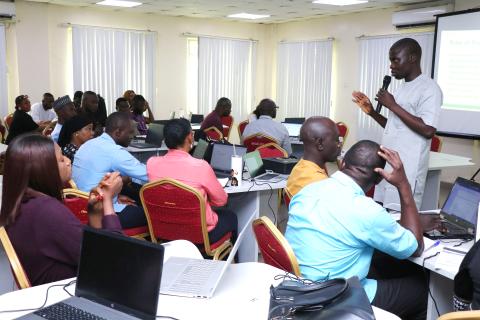
In furtherance of this vision, he organised intensive, practical training programmes for staff across CMDU's sections to enhance their professional competence and prepare them for emerging demands in course materials development.
During one of the training sessions for Instructional Designers, Dr Bello charged participants to make meaningful contributions wherever they found themselves, declaring: "Make impact anywhere you find yourself."
His emphasis on capacity building reflects an understanding that institutional transformation requires not only effective leadership but also a skilled, motivated, and professionally equipped workforce.
One significant innovation introduced under Dr Bello's leadership is the adoption of a collaborative digital workflow that will enable Instructional Designers and Subject Experts to work simultaneously on Google Docs.
According to him, the approach is expected to improve coordination, accelerate course development, and enhance the quality of instructional materials.
Google Docs, an online word-processing application developed by Google, allows multiple users to create, edit, review, and share documents simultaneously. Its collaborative features, including comments, suggestions, and automatic saving, provide an effective platform for interaction between Subject Experts and Instructional Designers.
The initiative is particularly relevant to NOUN's ODL operations, where timely production, review and delivery of course materials are essential to effective academic administration.
Speaking during a recent capacity-building programme for Instructional Designers, Dr Bello underscored the complementary responsibilities of the two professional groups.
"We are training you so that the university will continue to produce quality course materials for its numerous students. Subject Experts determine what to learn, while Instructional Designers determine how to learn," he said.
The statement captures the fundamental relationship between subject knowledge and instructional methodology in the development of effective learning materials.
The training programmes also exposed Instructional Designers to NOUN's prescribed ODL writing style, covering the development of course introductions, learning outcomes, sections and subsections, assessment activities, scenarios and case studies.
Particular attention was given to the responsible application of Artificial Intelligence (AI) tools in instructional design, with emphasis on improving productivity while maintaining academic standards and originality.
Following the training, participants were assigned existing course materials for review, giving them an opportunity to demonstrate and apply the knowledge and skills they had acquired.
Another important area of focus was Open Educational Resources (OER). The Instructional Designers were introduced to the principles of identifying and using appropriate online educational resources while observing copyright regulations, proper attribution, and avoiding plagiarism.
These initiatives are expected to broaden the professional capabilities of CMDU staff and strengthen the university's capacity to produce relevant, engaging and internationally competitive learning materials.
Notably, Dr Bello's leadership has also ushered in a renewed emphasis on developing more interactive and learner-friendly course materials that incorporate QR codes, hyperlinks, and relevant illustrations.
He explained that students would be able to scan QR codes or click embedded links to access supplementary videos and other learning resources that provide further explanations of course topics.
This approach is expected to enrich the learning experience, promote independent study and provide students with access to additional learning opportunities beyond conventional text-based materials.
The developments taking place within CMDU suggest a renewed commitment to improving the quality and delivery of instructional materials at NOUN. The combination of professional capacity building, digital collaboration, innovative instructional design, and the responsible use of emerging technologies offers considerable prospects for the unit's transformation.
With sustained institutional support and effective collaboration among stakeholders, CMDU has the potential to emerge as a model for course materials development among Open and Distance Learning institutions within the Commonwealth and beyond.
However, achieving this ambition requires collective responsibility. Heads of Departments, Subject Experts, Instructional Designers, Formatters and Editors must recognise that the success of course materials development depends on their cooperation, professionalism and commitment to established quality standards.
Dr Lukuman Kolapo Bello's experience, academic background and emerging leadership initiatives provide a promising foundation for this transformation. His ability to translate the vision into sustainable institutional achievements will ultimately determine the extent of CMDU's progress.
As NOUN continues to expand its reach and strengthen its position as a leading ODL institution, the quality of its course materials must remain a top priority. Supporting CMDU's renewed direction is therefore not merely the responsibility of its staff but a collective investment in the university's academic future.
Sunday Adama is a staff member of the Course Materials Development Unit (CMDU), Directorate of NOUN Press, National Open University of Nigeria (NOUN). E-mail: adamasonism@gmail.com.
- Log in to post comments
- 4 views