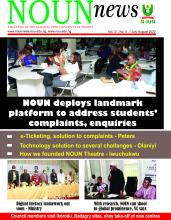
The National Open University of Nigeria (NOUN) has reaffirmed its commitment to repositioning its study centres as critical pillars of the university’s operations and enhancing the quality of services provided to learners across the country.
The Vice-Chancellor, Prof. Uduma Oji Uduma, represented by his deputy in charge of academics, Prof. Chiedu Mafiana, stated this on Monday, August 24, 2026 at a Study Centre Staff Retreat held at the Uyo Study Centre, Akwa Ibom State.
Professor Mafiana said the restoration of the study centres to their pride of place was a major priority of the Vice-Chancellor's administration, stressing that the centres remained the primary points of interaction between the university and its learners.
According to him, the effectiveness of the study centres significantly influences the overall performance of the university, as most learners interact more frequently with the institution through the centres than through its headquarters.
He noted that the Vice-Chancellor had already demonstrated his commitment to strengthening the centres through several initiatives, including ensuring that examinations were conducted at some study centres where such examinations had previously not taken place.
Mafiana explained that the retreat was designed not only to provide training but also to create an avenue for meaningful interaction between study centre personnel and the University Management.

He encouraged participants, particularly experienced study centre directors, to share their practical experiences and insights, noting that such contributions could help the university identify areas requiring policy adjustments and improve study centre administration.
The Deputy Vice-Chancellor also disclosed that the University Management was working towards fostering stronger collaboration and networking among study centres across the various geopolitical zones.
He further emphasised the need to comply with the Vice-Chancellor’s directive that activities and materials moving to and from the study centres should be coordinated through the Directorate of Learner Support Services (DLSS).
Earlier, the Director, Learner Support Services, Prof. Tessy Angba, said the retreat was organised to strengthen service delivery and promote a common understanding among study centre personnel on how to improve administration and enhance the learner experience across the university’s centres.
Speaking on the theme of the retreat, “Strengthening Learner Support Services for Effective Study Centre Administration,” Prof. Angba described the study centres as the most important points of contact between the university and its learners.
She noted that for many NOUN students, the study centre represents their most direct experience of the university, serving as the place where they obtain information, clarification, guidance, academic support and other forms of assistance throughout their academic journey.
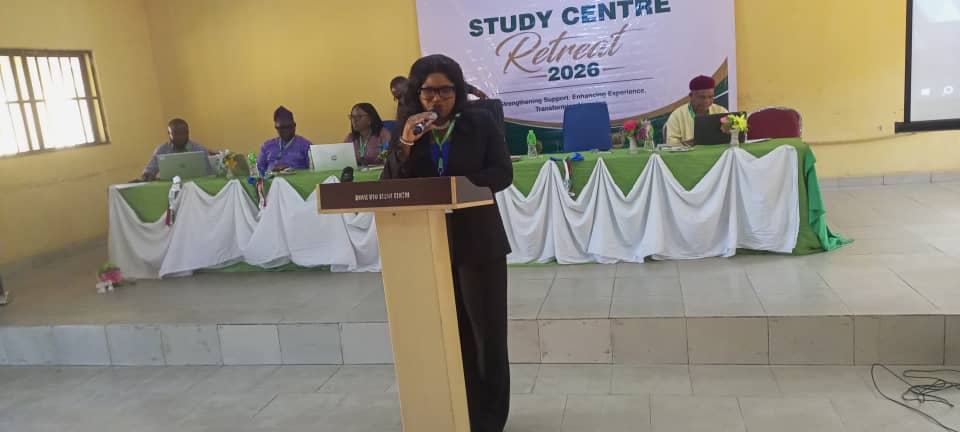
Angba stressed that the quality of learners’ experiences at the centres was crucial to the university’s reputation, observing that students might not remember specific policies or the names of university officials but would remember whether they were treated with respect, listened to and provided with effective assistance.
She, therefore, urged all categories of staff to see themselves as learner support officers, irrespective of their specific duties.
According to her, personnel in administration, examinations, counselling, Information and Communication Technology (ICT), finance, academic support, security, cleaning and other service areas all contribute directly or indirectly to the learner experience.
She emphasised that seemingly routine interactions, including answering telephone calls, responding to enquiries, processing requests, handling complaints, providing information and directing learners to the appropriate offices, could significantly influence students’ perception of the university.

Prof. Angba said the retreat was intended to promote a shared commitment among staff to effective, responsive and respectful learner support, noting that quality service delivery at the study centres was essential to achieving the university’s broader academic objectives.
The retreat brought together study centre directors, heads of administration, centre counsellors, accountants and ICT personnel from various centres for interaction, knowledge sharing and discussions on strategies for strengthening learner support services and improving study centre administration.
- Log in to post comments
- 732 views