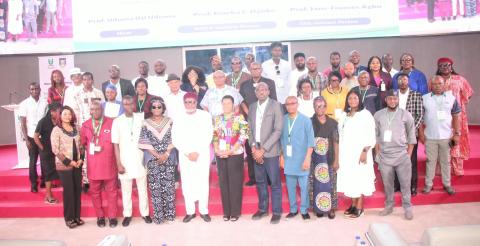
In a bold, forward-looking move, the National Open University of Nigeria (NOUN) has joined forces with the prestigious Commonwealth of Learning (COL) to create a groundbreaking institutional framework for micro-credentials, a strategic leap designed to power employability, lifelong learning and Nigeria's fast-evolving digital economy.
The landmark four-day workshop, which kicked off on Monday, 5th October 2026 and runs till 8th October 2026 in Abuja, is part of COL's ambitious Commonwealth-wide project to help member nations build credible, flexible and quality-assured micro-credential ecosystems.
The high-level workshop has drawn a rich blend of NOUN's top management, seasoned academics, professional staff, officials of the National Universities Commission (NUC), COL experts, and critical stakeholders to craft and consolidate NOUN's pioneering micro-credentials policy and set the stage for pilot courses.
Declaring the workshop open, the Vice-Chancellor of NOUN, Professor Uduma Oji Uduma, represented by the Deputy Vice-Chancellor, Academic, Professor Chiedu Mafiana, described the initiative as a defining moment for the university.
“Today we're not simply opening another workshop. We are taking an important step towards shaping the future of flexible, lifelong and technology-enabled learning in the National Open University of Nigeria,” he said.
He noted that micro-credentials offer NOUN a golden opportunity to expand access, rapidly respond to emerging skills gaps, boost graduate employability and champion lifelong learning, stressing that the university's vision must transcend short courses to building a robust, credible, flexible, scalable and sustainable micro-credential system.
On behalf of COL, Professor Jane-Frances Agbu, Adviser, Higher Education, said the Abuja workshop marks the first phase of COL's engagement with NOUN, with the second phase focused on developing cutting-edge micro-credential courses.
She explained that NOUN's initiative is anchored within COL's broader Commonwealth agenda involving regional consultations, national policy development and institutional pilots to strengthen coherence between policy and practice.
“The value of micro-credentials rests not simply on their short duration or flexibility. The credibility of micro-credentials depends on a well-articulated policy guideline,” she emphasized.
Professor Agbu underscored the urgency of micro-credentials in a world being reshaped by artificial intelligence, digital transformation and shifting employment patterns, noting that continuous learning, unlearning and relearning has become indispensable for survival and relevance.
Reaffirming the regulator's full backing, Dr. Fumilayo Morebise, who represented the NUC Executive Secretary, Professor Abdullahi Yusuf Ribadu, said the Commission is working hand-in-hand with COL to drive Nigeria's national micro-credential agenda.
“The micro-credential has been a major burning issue. And NUC, as a responsive commission, we don't want Nigeria to lag behind,” she said.
According to her, the national framework and emerging guidelines provide a solid foundation for institutional implementation, with NOUN proudly serving as one of the pilot institutions. Lessons from NOUN's experience will help refine the national guidelines before a wider rollout.
The workshop also critically examined findings from an institutional readiness assessment conducted at NOUN, spotlighting opportunities and gaps in policy and governance, quality assurance, staff capacity, digital credentialing, industry recognition, recognition of prior learning, credit transfer and stackability, assessment integrity, artificial intelligence and technical infrastructure.
At the end, the workshop is expected to equip NOUN with a resilient, future-proof institutional micro-credential ecosystem that empowers learners, satisfies employers and accelerates national human-capital development, while contributing significantly to the Commonwealth's drive for trusted, relevant and transformative micro-credential provision.
- Log in to post comments
- 14 views