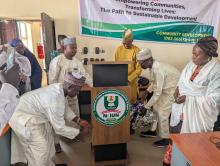
The Deputy Vice-Chancellor, Technology, Innovation and Research (TIR) of the National Open University of Nigeria (NOUN), Prof. Christine Ofulue, has underlined the university's commitment to supporting research innovations with the potential for commercialisation, job creation and improved quality of life for Nigerians.
Ofulue gave the assurance during her visit to the 2nd TETFund National Research Fair and Exhibition in Abuja, where she interacted with exhibitors showcasing locally developed innovations in healthcare and food processing.
She said NOUN was prepared to support viable research initiatives, particularly those addressing practical challenges facing Nigerian families, creating employment opportunities and promoting the use of locally available materials.
At one of the exhibition stands, Ofulue commended a physiotherapy innovation developed to support the rehabilitation of children with neurological disorders, particularly cerebral palsy and other developmental conditions.
The research team explained that children undergoing rehabilitation require continuous treatment as they grow, often necessitating replacement of their therapy devices or slabs. This places additional financial burdens on parents and caregivers.
"The challenge is that when a child comes for rehabilitation, they will need to continue treatment because children grow very fast. They have to come back to get a new one. Imagine a mother being told she has to pay again," the team explained.
The device, developed entirely from locally sourced materials, is designed for simplicity and ease of use. It allows a child to sit on the equipment and undergo therapy without the need for complex and expensive imported alternatives.
According to the researchers, the next phase of development involves integrating a monitoring device that can read the impulses generated during physiotherapy sessions.
Similar to a blood pressure monitor that displays waveform patterns, the proposed technology would enable physiotherapists to generate reports assessing treatment effectiveness, particularly improvements in children's movement coordination.
Ofulue encouraged the researchers to accelerate the development of the next phase, assuring them of the University's readiness to support efforts to move the innovation from exhibition to production and wider adoption.
At another exhibition stand, the Deputy Vice-Chancellor described a locally developed fermentation and food-processing innovation as simple and highly innovative, while emphasising the need for access to clean and affordable energy to sustain and expand production.
The exhibitors explained that the processing method involves applying pressure after cooking to preserve the product's quality and prevent it from losing its desired characteristics.
The product is subsequently washed and dried before undergoing fermentation and packaging.
They added that the packaged product could be marketed in its existing form or subjected to further mechanical processing, depending on the desired end product.
Regarding market expansion, the team disclosed that the high cost of exporting had made the domestic market its immediate priority, particularly to meet local demand for the product and its processing.
They also revealed that cooperatives were being explored as a distribution channel to reach a wider market.
In response to the presentation, Ofulue stressed the importance of affordable and reliable energy for scaling up locally developed innovations.
"How easy is it for them to get gas? That's another thing. We need clean energy," she observed.
She commended the researchers for developing a process that facilitates uniform heat application and simplifies production, describing the innovation as easy to use and promising.
"This is very easy and innovative. Maybe when you have done some more work on it, I will see how to get in touch with you," she said.
Ofulue encouraged the exhibitors to continue refining their innovations, reiterating NOUN's interest in supporting research outcomes that can be translated into practical solutions, create employment, strengthen cooperatives and contribute to growth in healthcare, food processing and the wider economy.
- Log in to post comments
- 2 views