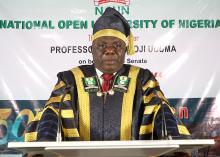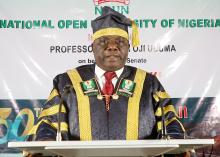
The Vice-Chancellor of the National Open University of Nigeria (NOUN), Prof. Uduma Oji Uduma, has said relational epistemologies represent one of the most profound philosophical conversations of our time, and that African philosophy has long embraced relational thinking.
Prof. Uduma spoke on Thursday, July 9, 2026, during the Department of Philosophy’s 3rd Lecture Series in Abuja. The lecture was themed: “Relational Thinking: On the Challenges of Relational Epistemologies.”
He delivered his remarks via Zoom, noting that his submission carried the weight of both a philosopher and the VC of an institution charged with the creation, preservation, and dissemination of knowledge.
“What does it mean to know? Who is the knower? Under what conditions is knowledge possible? What is the relationship between the individual, the community, and truth?” he queried.
The VC argued that much of modern epistemology, since René Descartes, has been dominated by the idea of an autonomous, rational subject.
“Whether through rationalism or empiricism, knowledge was often conceived as the achievement of an individual consciousness seeking certainty through detached reflection or sensory experience,” he said.
According to him, in that model the knowing subject was abstracted from history, culture, language, and community.
Prof. Uduma, a Professor of Logic and Barrister of the Law, however contended that relationality is neither unfamiliar nor novel in African philosophy.
“Across the continent, relationality has long constituted a foundational principle of metaphysics, ethics, politics, and epistemology,” he said.
“African philosophy does not approach relational thinking as a newly discovered intellectual fashion. It approaches it as one of its enduring philosophical inheritances.”
Earlier, Ag. Head of Department, Dr. Helen T. Olujede, gave the citation of the guest lecturer, Prof. Anke Graness of the University of Hildesheim, Germany.
Graness’s research interests include the history of philosophy, philosophy in Africa, intellectual history, global justice, and feminist theory.
The two-hour virtual lecture featured Questions and Answers session moderated by Dr. Uduagwu and Dr. Afoka, with Dr. Umar Bala giving the recapitulation of the main arguments.
- Log in to post comments
- 690 views