As the National Open University of Nigeria (NOUN) prepares to host its 42nd Inaugural Lecture, the occasion offers more than an opportunity to celebrate the academic accomplishments of a distinguished scholar. It provides a moment to reflect on the place of inaugural lectures in the University's intellectual journey and their enduring role in advancing scholarship, stimulating public discourse and contributing to national development.
Since its establishment, NOUN has distinguished itself as Nigeria's premier Open and Distance Learning (ODL) institution, expanding access to higher education for thousands of learners across the country and beyond. Alongside this mandate, the University has steadily cultivated a vibrant culture of research, scholarship and knowledge production. One of the most visible expressions of this intellectual tradition is its inaugural lecture series.
An inaugural lecture is widely regarded as one of the highest academic traditions in the university system. It provides a platform through which a professor formally presents the substance of years of teaching, research, professional engagement and contributions to knowledge.
More importantly, it enables the university community and the wider public to appreciate how academic inquiry can offer practical solutions to societal challenges.
The growing number of inaugural lectures delivered at NOUN reflects the University's steady academic maturation. The lectures underscore the institution's determination not only to democratise access to education but also to contribute meaningfully to national development through research-driven ideas and solutions.
Across the world, inaugural lectures offer professors an opportunity to present the essence of their academic work, trace the trajectory of their research and demonstrate how their scholarship contributes to the advancement of society.
At NOUN, the tradition has become an important avenue for showcasing intellectual achievement while connecting academic knowledge with contemporary national and global concerns.
The forthcoming 42nd Inaugural Lecture represents another significant milestone in this growing legacy of scholarship. It reflects the University's continuing commitment to promoting intellectual engagement and showcasing the expertise of its professors across diverse disciplines.
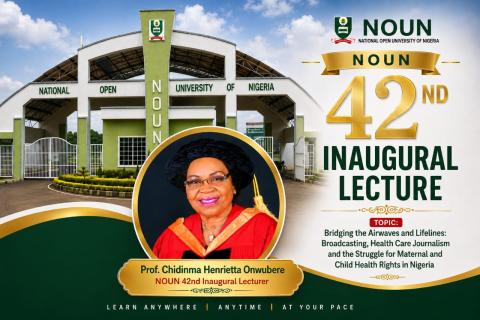
The lecture will be delivered by Professor Chidinma Henrietta Onwubere, a Professor of Broadcasting whose academic career has been devoted to exploring the intersections of communication, development and public welfare.Her lecture, titled “Bridging the Airwaves and Lifelines: Broadcasting, Healthcare Journalism and the Struggle for Maternal and Child Health Rights in Nigeria,” addresses an issue that lies at the heart of national development and human well-being.
The theme is both timely and significant. In a country where maternal and child health outcomes continue to attract national and global attention, the role of the media in shaping awareness, influencing public behaviour and promoting accountability has become increasingly important.
By examining the relationship between broadcasting, healthcare journalism and health rights, Professor Onwubere's lecture is expected to illuminate how strategic communication can contribute to improving healthcare outcomes and advancing the rights of vulnerable populations.
The media, particularly broadcasting, plays a pivotal role in shaping public understanding of health issues, encouraging behavioural change and amplifying the voices of vulnerable groups. Through responsible and effective healthcare journalism, broadcasters can help bridge information gaps, promote accountability and support efforts aimed at improving health outcomes for mothers and children.
The choice of the subject also demonstrates the broader value of inaugural lectures. Beyond celebrating individual academic achievement, such lectures provide a platform for professors to connect years of research with real-world concerns. They bring scholarly insights into public conversations and demonstrate how universities can contribute meaningfully to addressing societal problems.
Over the years, NOUN's inaugural lecturers have explored issues spanning education, technology, management, law, health sciences, agriculture, communication and the humanities. Collectively, these lectures have enriched academic discourse, stimulated further research and reinforced the University's standing as a centre of excellence in teaching, learning and knowledge creation.
Inaugural lectures also serve as an important bridge between the university and society. While many academic findings are often confined to scholarly journals and specialised publications, the inaugural lecture opens up research to policymakers, professionals, students, industry stakeholders and members of the public. In doing so, it helps transform research from a purely academic exercise into a tool for societal progress.
For students and emerging scholars, the lectures are equally inspiring. They demonstrate the value of perseverance, intellectual curiosity and sustained scholarly engagement. They remind younger academics that research is not merely about earning qualifications or advancing careers, but about generating ideas capable of improving lives, influencing policy and shaping communities.
As NOUN marks its 42nd Inaugural Lecture, therefore, the University is not simply adding another event to its academic calendar. It is celebrating a tradition that has become central to its identity as a knowledge-driven institution.
Each inaugural lecture delivered over the years represents another contribution to the University's expanding intellectual heritage and another affirmation of its commitment to academic excellence.
The forthcoming lecture by Professor Onwubere is, therefore, more than a personal academic milestone. It reflects NOUN's evolving research culture, its dedication to addressing contemporary challenges through scholarship and its belief in the transformative power of knowledge.
In a rapidly changing world where information shapes decisions and communication influences development outcomes, the subject of the 42nd Inaugural Lecture resonates far beyond the lecture hall. It speaks to the critical role of the media in safeguarding public health, amplifying the voices of vulnerable populations and supporting the quest for a healthier and more equitable society.
Ultimately, the 42nd Inaugural Lecture stands not only as a landmark in the academic journey of Professor Chidinma Henrietta Onwubere, but also as another important chapter in NOUN's own academic journey—a journey defined by scholarship, innovation and an unwavering commitment to deploying knowledge as a force for national development and social progress.
As NOUN continues to expand its frontiers in teaching, research and community service, the inaugural lecture tradition remains a powerful reminder that the true measure of scholarship lies not only in the creation of knowledge, but also in its capacity to illuminate society's challenges and inspire meaningful change.
Debbie Nduba is a staff of the Directorate of Media and Publicity, NOUN.
- Log in to post comments
- 827 views